



Closing The Sandwich Shop
As another media-industry stalwart shuts down, it remains essential for media outlets to control their own destinies.
Today, as Anthropic’s AI takes over the stock market, it’s more than a little weird to write a little lament to the way the internet once was.
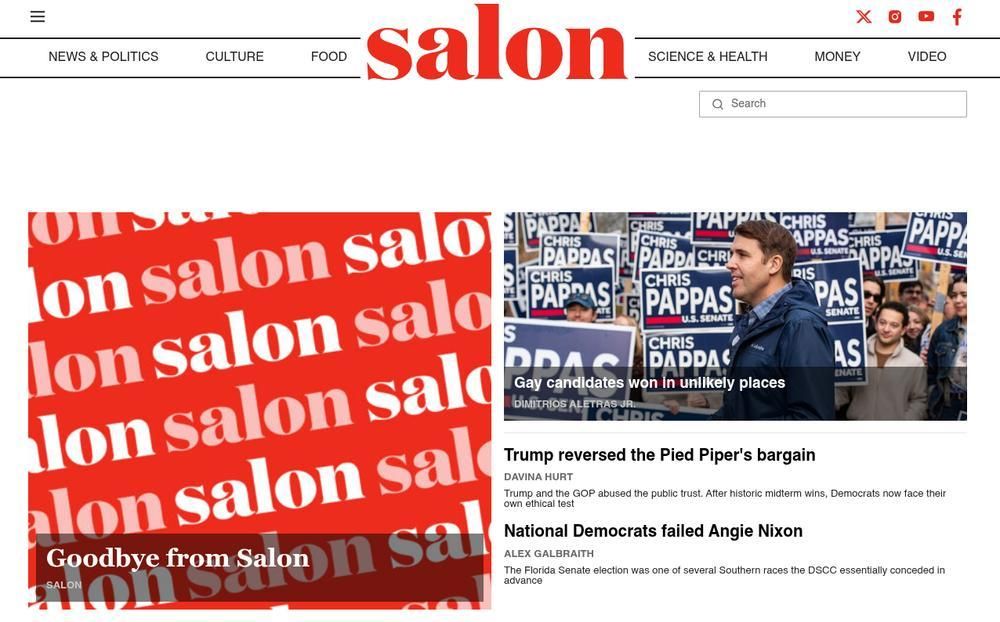
But we recently lost Salon, one of the few news sites that’s been here more or less the entire time. And the reason cited sounds quite familiar:
The business realities of independent digital journalism have changed profoundly over the years. After careful consideration, we have reached the difficult decision that our publishing model is no longer sustainable.
I’m sure that’s certainly true. But I also know that Salon has likely hit more of those road bumps than most. When it started, it was a site build around news, yes, but also a robust comments section. Then it gave that up, willingly. As I wrote in an aside earlier this year:
A testament to its legacy: Salon used the software as the anchor of its digital community for more than 15 years, only shutting it down in 2011 out of concerns it wasn’t where the Web was going. With another 15 years of retrospect, can we argue that this was probably a bad move? Perhaps.
I don’t want to argue prescience, but I do think decisions like these, where we handed off the infrastructure of our own destines to other companies in hopes that maybe they’d have a better idea than we would? They ultimately cost us necessary momentum and foundational strength.
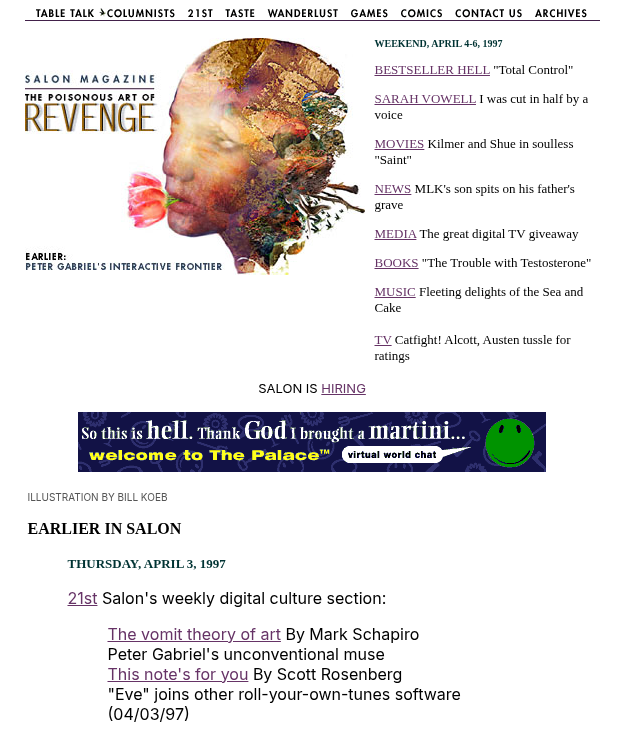
The thing is, media outlets like Salon, which got its initial seed funding from Apple and Adobe (and Adobe continued to financially support for years after its launch), have long been swimming upstream. It had to ride a series of technology trends (search, social, video) to stay afloat. It wasn’t like Salon had originated any of these; it had to survive on the back of a tech ecosystem that saw financial opportunity in journalism, but not enough to build around it forever.
(It’s not like Adobe has invested millions of dollars in Salon anytime recently, after all. Free idea, Adobe: Maybe do that. Would be a great goodwill opportunity, considering the creatives you’ve frustrated of late.)
Matt Wolfbridge, the editor of the great Typebar Magazine which I’ve contributed to in the past, wrote a loving, but honest, take about where Salon went. He arrived there after its initial heyday, the period that gave us Joan Walsh and later Glenn Greenwald. While he was there, he grew its social presence in a big way. He didn’t hide its flaws, but he did note how much he loved the thing:
Everyone was happy for me when I did leave Salon for a surging news startup, which I did with a degree of sadness. Salon was the first thing in my professional life that had ever gone right. And it was staffed by many brilliant people whose devotion to the written word was so great they put up with the ownership’s demands. I am grateful for the time I spent there.
I didn’t work at Salon. I can’t claim any sort of institutional knowledge of what was there, like Matt can. But what I can say is that stuff like this makes me endlessly sad.
Salon’s late-stage owner: A reflection of 31 years of pivots?
Salon, in its own way, has reflected all the good and bad trends of digital-first journalism over the past 31 years. The most recent trend it reflected? The weird owner nobody who ever of, taking it over, Bending Spoons-style.
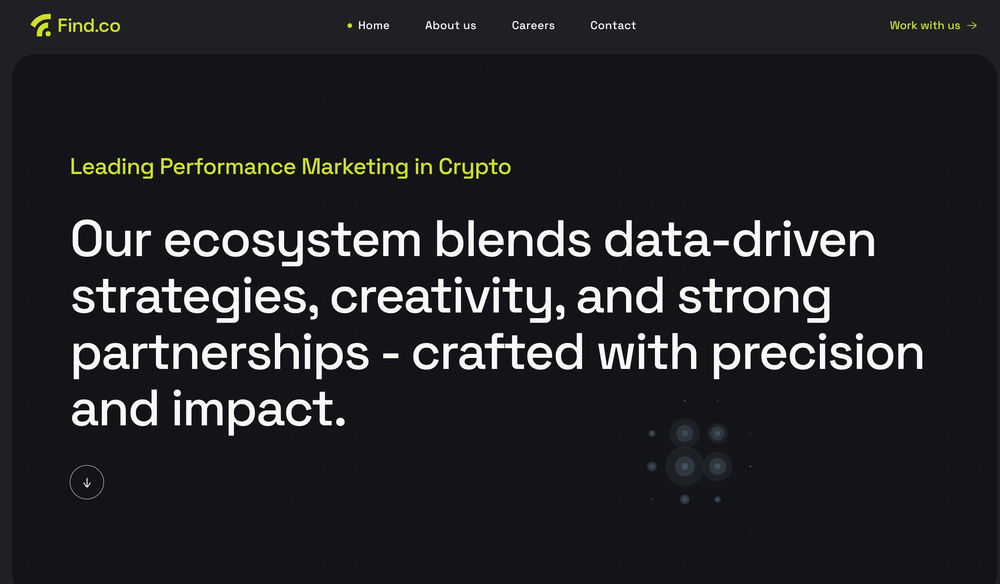
That’s right, Salon went down the same road that another great site in the internet’s digital legacy, Deadspin, did. It, too, was sold to a company based in Malta, with a background in iGaming, the shorthand term for “online gambling.” Salon, whatever its qualities before this shutdown happened, stuck out like a sore thumb in the context of Find.co’s product catalog.
“Leading Performance Marketing in Crypto” is not something one would associate with a long-running publication. But when I read “company that has crypto and iGaming interests buys website with 31 years of SEO juice,” I think to myself, “Oh, they want the Google ranking, not the outlet.”
I could be wrong. Maybe the Find.co folks are perfectly nice people who thought it’d be fun to make a bet on traditional journalism at a time when it seems like nobody else was.
But given the way that media brands get put through the wringer by both internal and external technology partners, it’s not hard to look at situations like these with a raised eyebrow. After all, today it’s Salon. Tomorrow, it could be another legendary site. The problem with building empires on the shared infrastructure of others is that they’re changing the infrastructure even if you don’t want them to. You’re forced to react to it at all times.
And sometimes, those companies don’t even know what the hell they’re doing, either. I’ve been following the recent SEO-website headlines with great interest after it came out that Google’s AI Mode, a search feature that the company heavily pushed onto its search engine, was less profitable than the old version of Google. And that has led Google to test minimizing it in searches. (Unfortunately, that doesn’t include the much-maligned AI overviews, but hey, at least &udm=14 exists.)
That’s telling. Like the infamous Facebook-driven pivot to video that was based on inflated data, an entire industry has been forced to leap based on bets that another company is making without knowing that what they’re doing is actually working.

What a legendary Wawa can teach you about top-down decision-making
Recently, I was on the home page of The Virginian-Pilot, a paper where I once helped start a free daily newspaper, reading about how a community was protesting in an attempt to save a beloved Wawa location. The story I think offers a neat parallel for the challenges journalism faces. This location meant a lot to the students of William & Mary, but Wawa wants more stores with attached gas stations. Classic example of making a 30,000-foot decision without looking at what’s happening on the ground.

The tech industry is full of decisions like these, where bold bets are made at a high level without understanding where the value equation actually lies. Our latest initiative requires us to strategically pivot towards gas stations, so we must stop serving 19-year-olds who want a hoagie in the middle of the night. We need to push people towards AI so we keep them on site longer, so we hurt all the symbiotic relationships we created over the past 30 years.
At the bottom of the Pilot article, my eye was drawn to the fine print, presumably put there by the Tribune bosses:
The use of any content on this website for the purpose of training artificial intelligence systems, algorithms, machine learning models, text and data mining, or similar use is strictly prohibited without explicit written consent.
We are now past the point where media outlets are going to be nice about it. They’ve been burned way too many times. This top-down stuff is gonna cost us everything we actually care about if we don’t stop it.
Sandwiched Links
Shuffling alone: The website Solitaire Alone Together is both a compelling website and a statement on the loneliness epidemic gripping society. (↬ Jared Newman)
Listen, as lawyers go, Lowell “The Hammer” Stanley is as close as you’ll find to a real-life Saul Goodman. Which is why it’s shocking to learn that, like Goodman infamously once did, Stanley just had his law license suspended.
Just wanted to offer a quick shout to zsKnight, the developer of ZSNES, who has made an utterly charming game collection called Retro Endurance 8 Bit. The gimmick: The game keeps changing, channel-clicker style, as you rush through levels. (Think Action 52/UFO 50, but with a quirky sense of humor all its own.) Find it on Steam here.
--
Solidarity with the William & Mary students trying to save their Wawa. Find this one an interesting read? Share it with a pal!
And in case you wanna support us, give the Tedium Shopping Network a look.
